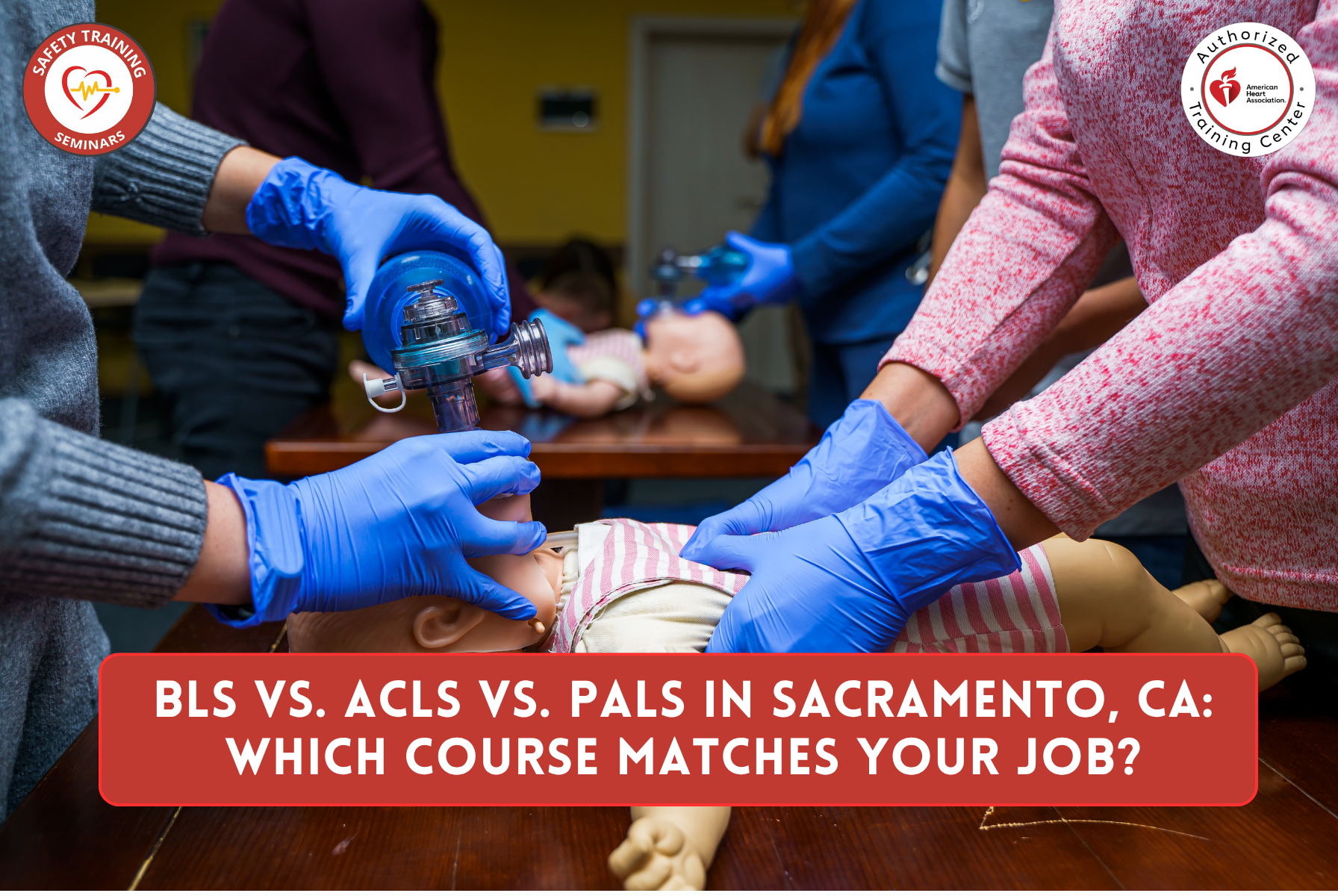
If your employer, school, clinical program, or licensing process has told you to complete life-support training, the course name matters. In Sacramento, CA, BLS, ACLS, and PALS are not interchangeable. BLS focuses on core CPR, AED use, and ventilation skills. ACLS builds on those fundamentals for adult cardiovascular emergencies, while PALS focuses on serious emergencies involving infants and children.
For many healthcare workers, BLS is the starting point. Higher-acuity adult roles may also require ACLS, while pediatric roles may require PALS. Confirm the exact requirement with your employer, school, clinical site, or licensing body before registering.
Key Takeaway: If a Sacramento job posting or school requirement says “BLS,” do not substitute ACLS or PALS unless the organization specifically allows it. Some healthcare roles require BLS plus one or both advanced courses.
BLS, ACLS, and PALS at a Glance
The easiest way to choose is to match the course to the type of patient care and emergency responsibility in your role.
| Course | Main Focus | Common Fit |
| BLS | CPR, AED use, ventilations, and basic life-support response | Healthcare professionals and others who need healthcare-level CPR skills |
| ACLS | Advanced management of adult cardiac arrest and cardiovascular emergencies | Clinicians involved in emergency, critical, intensive, or advanced adult care |
| PALS | Recognition and management of serious emergencies in infants and children | Clinicians who care for pediatric patients in emergency or higher-acuity settings |
The American Heart Association describes BLS as training in CPR, AED use, and ventilations. ACLS is designed for healthcare professionals who direct or participate in managing cardiac arrest, stroke, and other cardiopulmonary emergencies, while PALS is intended for professionals responding to emergencies in infants and children.
When a BLS CPR Certification Course Is the Right Starting Point
BLS stands for Basic Life Support. It centers on the immediate skills healthcare professionals may need when someone has a life-threatening breathing or cardiac emergency, including CPR, AED use, and ventilation skills.
A BLS CPR Certification Course is often relevant for nurses, nursing students, medical assistants, dental professionals, EMTs, and others whose employer or program specifically requests healthcare-provider BLS. Job titles alone do not determine the requirement; department, patient population, and employer policy can change what is needed.
BLS should also not be confused with a general CPR or First Aid class. Teachers, fitness professionals, parents, workplace employees, or childcare providers may be asked for a different CPR/AED or First Aid credential. Check the exact wording on your employer, school, or program documentation.
When Your Role May Require ACLS in Addition to BLS
ACLS stands for Advanced Cardiovascular Life Support. It builds on basic life-support skills and is intended for professionals who manage or participate in more complex adult cardiovascular emergencies.
That often includes professionals in emergency response, emergency medicine, intensive care, or critical care who may participate in treating adult cardiac arrest, stroke, arrhythmias, or related emergencies. ACLS is not simply a “higher level” replacement for BLS; a role may require both.
For example, a nurse moving into an emergency or critical-care role may find that BLS alone no longer satisfies the employer’s requirements. Check the department’s onboarding or renewal instructions rather than assuming ACLS automatically covers a BLS requirement.
PALS Is Designed Around Pediatric Emergencies
PALS stands for Pediatric Advanced Life Support. Its focus is the recognition and management of serious emergencies affecting infants and children, including respiratory and cardiovascular problems.
PALS is especially relevant to healthcare professionals who regularly encounter pediatric patients in emergency response, emergency medicine, intensive care, or critical-care environments. A pediatric nurse, emergency clinician, paramedic, or other provider may therefore be asked to maintain PALS in addition to BLS.
The key distinction is patient population. ACLS centers on advanced adult emergencies; PALS centers on pediatric emergencies. If you work with both adults and children, your employer may require more than one course. Choose based on the credential named in your job or program requirements, not simply on which course sounds more advanced.
What If Your Sacramento Job Requires More Than One Course?
Some clinical roles require a combination of credentials. A healthcare professional may need BLS as the foundation and then ACLS or PALS because of the patients and emergencies encountered in the role. In some settings, all three may be requested.
Verify requirements when changing departments, starting clinical rotations, accepting a new position, or renewing. Ask for the exact course name and whether a particular training standard is specified.
For people outside clinical care, the answer may be different. Teachers, childcare providers, coaches, workplace teams, parents, and caregivers may need CPR, AED, First Aid, or pediatric-focused training rather than ACLS or PALS.
Blended Learning Still Includes a Hands-On Component
Course format can also cause confusion. The American Heart Association offers blended-learning options for BLS, ACLS, and PALS. In blended learning, students complete an online portion and then complete a hands-on skills session.
That matters if an employer or school requires demonstrated skills rather than an online-only course. The Sacramento Midtown page for Safety Training Seminars currently lists BLS, ACLS, and PALS in an online-plus-skills format. Before registering, review the current course details and confirm that the format matches your requirement.
If you are coming from outside central Sacramento, you can also review CPR, BLS, ACLS, and PALS courses in North Highlands or life-support course options serving Orangevale.
Choosing a Sacramento Training Location Based on the Course You Need
Safety Training Seminars offers local healthcare and CPR training at its Sacramento Midtown location: 2501 Capitol Avenue, Suite 107, Sacramento, CA 95816. You can review the specific BLS, ACLS, PALS, CPR, or First Aid course that matches your requirement and any required in-person skills component.
Students and professionals may travel from Parkway, Rio Linda, Rosemont, Vineyard, Wilton, North Highlands, and Orangevale depending on where they live, work, or attend school. If a nearby location is more suitable, review the Rio Linda CPR and advanced life-support course page or the Rosemont CPR, BLS, ACLS, and PALS course page before registering.
The main decision should still be course fit. Start with the credential named by your employer or school, then compare location and training format.
FAQs About BLS, ACLS, and PALS in Sacramento
Do nurses in Sacramento need BLS, ACLS, or PALS?
It depends on the nursing role and employer. BLS is commonly requested in clinical settings, while nurses working with higher-acuity adult patients may also need ACLS. Nurses caring for infants or children may be asked for PALS. Confirm the exact credential with your employer, clinical site, nursing program, or licensing-related organization.
Is ACLS a replacement for BLS?
Not necessarily. ACLS builds on basic life-support knowledge but serves a different purpose, focusing on advanced adult cardiovascular emergencies. An employer can require both BLS and ACLS, so completing ACLS should not be assumed to satisfy a separate BLS requirement.
Should pediatric healthcare workers take PALS instead of ACLS?
PALS is specifically focused on serious emergencies in infants and children, while ACLS focuses on adult cardiovascular emergencies. A pediatric-focused role may require PALS, but jobs involving mixed patient populations may require additional credentials. Confirm with the employer or clinical program.
Can I complete BLS, ACLS, or PALS entirely online in Sacramento?
A blended course can include online learning, but the AHA blended-learning model also includes a hands-on skills component. Safety Training Seminars’ Sacramento Midtown information currently describes online coursework plus skills testing for BLS, ACLS, and PALS. Verify the current format and your employer’s requirements before registration.
Can someone from Rio Linda, Rosemont, or nearby communities attend Sacramento training?
Yes. People from surrounding communities can choose a Sacramento-area option that fits their course requirement and current availability. Compare Sacramento Midtown with nearby location pages before registering.
Choose the Course That Matches the Requirement
For most people comparing BLS vs. ACLS vs. PALS in Sacramento, the decision comes down to three questions: What credential is specifically required? Do you work primarily with adults, children, or both? And does your role involve basic response skills or advanced management of cardiopulmonary emergencies?
BLS provides the core healthcare life-support foundation. ACLS adds advanced adult emergency-management skills, while PALS focuses on pediatric emergencies. Some professionals need only one course; others may need a combination.
Safety Training Seminars offers Sacramento-area course options for healthcare professionals and other learners. Before registering, confirm the exact requirement with your employer, school, clinical program, or licensing organization, then review the supplied course-location page that best matches your course and location for current availability, format, and registration information.